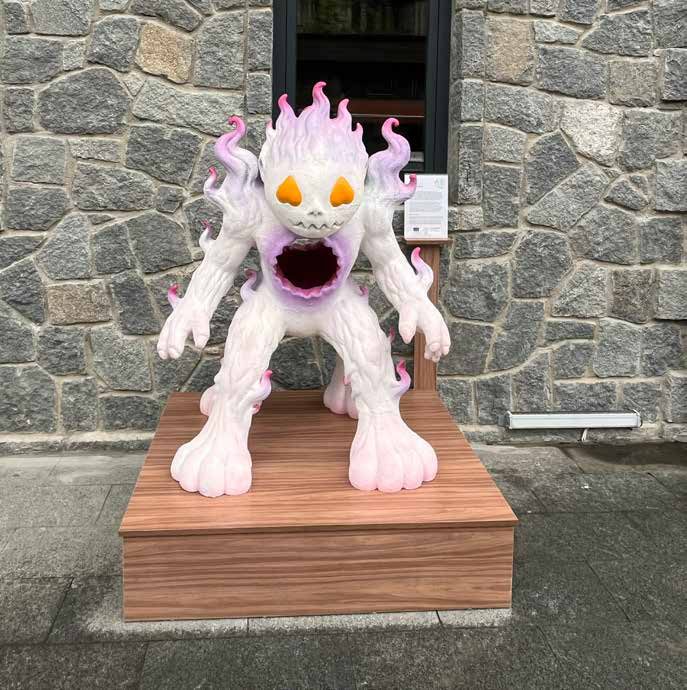
Taking its name from the Hemşin word for “toy,” Lilik is a research and production project that transforms the endangered oral narratives and mythological creature stories of the Hemşin region into large-scale, interactive public sculptures. Supported by the CultureCIVIC Culture and Art Support Programme, funded by the European Union, and developed in collaboration with Hemşin Yaşam Derneği, the initiative operates at the intersection of cultural preservation, land art, and social practice.
The work unfolds through a multi-phase methodology: beginning with the archival collection of surviving local folklore, progressing to the strategic installation of these physical forms in ecologically significant locations, and culminating in community workshops where local children help author and design an entirely new mythological character to reflect the town’s contemporary spirit. Moving away from static representation, the resulting installations are conceived as living, functional works of public art designed to be touched, planted with seeds, and inhabited as spaces of communal gathering. By combining large-scale 3D-printed structural nodes with locally sourced and recycled materials, the semi-temporary pieces integrate seamlessly into the natural landscape.
At the conceptual core of this work are the creature stories themselves, utilized for their inherent accessibility and their historical function as vessels for communal memory, social order, and ecological anxiety. The project materializes three specific liminal beings from local lore, projecting their symbolic roles directly into the physical traits and interactive functions of the sculptures.
The figure of Cazi, historically a mythic coping mechanism for the traumatic reality of exhausted, overworked mothers in a society heavily burdened by outward male migration, is reclaimed through a feminist lens, with her installation functioning as a dedicated physical space of rest and reprieve.
Karakoncolos, traditionally a symbol of winter scarcity used to keep children away from crops, is subverted into a bearer of abundance, featuring a body filled with soil for growing vegetables.
Similarly, Ubur, an embodiment of the deceased returning due to ungranted helallik (forgiveness) and broken communal communication, is turned into a site of reconciliation; fitted with a comforting hand on its back and a sharing plate in its chest, the installation transforms a symbol of punishment into an active exchange for mutual forgiveness and material sharing.
Finally, culminating this process of cultural evolution, the project introduces a newly authored figure: Lilik. Born from community workshops where local youth drew monsters based on their contemporary fears, Lilik diverges from traditional malignant spirits; instead, it emerged as a benevolent, landscape-scale guardian designed to clean the local lakes and protect both children and nature. Through these direct inversions and the collective creation of a new myth, the project revitalizes Hemşin’s oral folklore into an evolving, participatory dialogue embedded within everyday civic life.
GALLERY: /_astro/1.DOBHL-p7.jpg, /_astro/2.CxKELtqO.jpg, /_astro/3.BcrDx6B0.jpg, /_astro/4.DJ7ZugHG.jpg, /_astro/5.B_qGXUhA.jpg, /_astro/6.CLS1m7ua.jpg